
Introduction
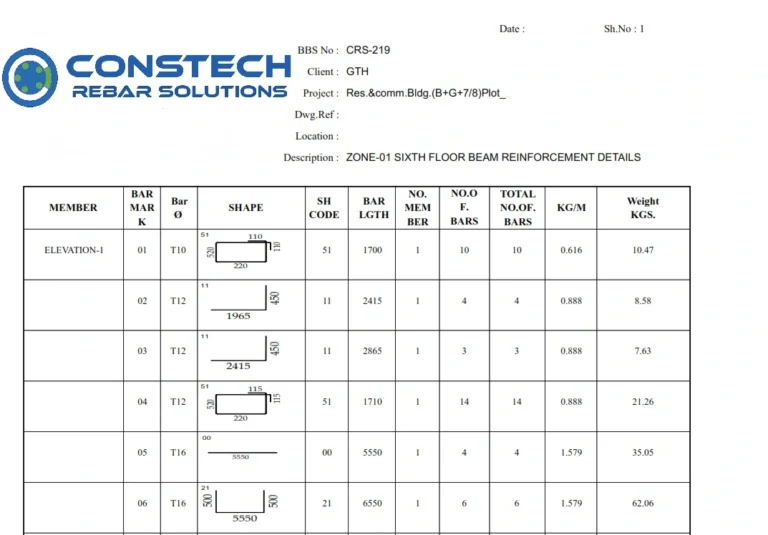
In reinforced concrete construction, a Bar Bending Schedule (BBS) is a critical document that directly impacts cost, accuracy, and construction efficiency. It provides a complete list of reinforcement bars, including shape, size, length, bends, and quantities required for a project.
However, one major challenge faced by international contractors and detailing companies is the difference between American (ACI-based) and British (BS 8666) standards.
If you are working on projects in Texas or across the USA, understanding these differences is essential for:
- Compliance with U.S. codes
- Avoiding fabrication errors
- Winning international rebar detailing contracts
What is a Bar Bending Schedule (BBS)?
A Bar Bending Schedule (BBS) is a structured table that includes:
- Bar mark and identification
- Diameter and grade
- Shape and bending details
- Cutting length
- Quantity and total weight
It acts as a bridge between design drawings and site execution, ensuring precise fabrication and installation of reinforcement steel.
Overview of Standards
ACI (American Standard – USA)
- Based on ACI 315 (Detailing Manual) and ACI 318
- Widely used across Texas, California, New York, and all U.S. states
- Focuses on:
- Practical detailing guidelines
- Bar placement clarity
- Constructability and safety
BS 8666 (British Standard – UK & International)
- Defines scheduling, dimensioning, bending, and cutting of reinforcement steel
- Uses standard shape codes (00, 01, 21, etc.)
- Highly structured and fabrication-oriented
ACI vs BS 8666 – Key Differences
1. Shape Representation
ACI:
- No fixed shape codes
- Shapes are shown using drawings + dimensions
BS 8666:
- Uses standardized shape codes
- Example:
- 00 → Straight bar
- 21 → U-shaped bar
👉 Impact:
BS is faster for fabrication; ACI is more flexible for design interpretation.
2. Measurement System
ACI (USA):
- Uses Imperial units (inches, feet)
- Sometimes dual units (Imperial + Metric)
BS 8666:
- Strictly metric (mm)
👉 For Texas projects:
Always convert correctly to avoid fabrication errors.
3. Bending & Hook Requirements
ACI:
- Defines hooks like:
- 90°, 135°, 180°
- Hook lengths based on bar diameter (d) and structural requirements
BS 8666:
- Provides:
- Minimum bend radii
- Standard bend allowances
- Predefined geometric rules
👉 Key Difference:
ACI is design-driven, BS is fabrication-driven.
4. Cutting Length Calculation
ACI:
- Calculated manually using:
- Bend deductions
- Development length
- Lap length
BS 8666:
- Uses formula-based shape code calculations
- Example:
- Length = A + B + C – deductions (based on shape)
👉 Impact:
BS allows automation and faster scheduling, especially in softwares.
5. Level of Standardization
ACI:
- Flexible, depends on engineer/drafter
- Requires interpretation
BS 8666:
- Highly standardized
- Same format across projects
👉 Impact for outsourcing:
U.S. clients often expect ACI-based customization, not rigid templates.
6. Software & Industry Practice
USA (ACI-based projects):
- Tekla Structures
- Revit + Navisworks
- AutoCAD with custom detailing
BS-based regions:
- Automated scheduling tools
- Shape-code driven outputs
Practical Example: Why It Matters for U.S. Projects
If you submit a BS-style BBS to a Texas contractor, issues may arise:
- Confusion due to shape codes
- Unit mismatch (mm vs inches)
- Rejection due to non-ACI compliance
👉 Instead, U.S. clients expect:
- Clear bar sketches
- Dimensions in feet/inches
- Compliance with ACI detailing practices
Which Standard Should You Use?
For USA / Texas Clients → Use ACI-Based BBS
✔ Preferred by:
- General contractors
- Structural engineers
- Fabricators
✔ Benefits:
- Easier approval
- Better coordination
- Higher chance of repeat business
For UK / Europe / Middle East → Use BS 8666
✔ Preferred where:
- Fabrication is automated
- Standardization is critical
✔ Benefits:
- Faster production
- Reduced ambiguity
FAQs – Bar Bending Schedule (ACI vs BS 8666)
1. What do U.S. contractors actually expect in a Bar Bending Schedule (BBS)?
U.S. contractors typically expect an ACI-style BBS that includes:
- Clear bar mark references linked to drawings
- Bar sketches (not just codes)
- Dimensions in feet and inches
- Bending details (hooks, laps, embedment)
👉 Unlike BS 8666, shape codes alone are not sufficient—visual clarity is critical for site teams and fabricators.
2. Why do some U.S. clients reject BS 8666 schedules?
Common reasons include:
- Use of shape codes (00, 21, etc.) unfamiliar to U.S. teams
- Metric units (mm) instead of imperial
- Lack of explicit bar geometry drawings
👉 In practice, many Texas contractors will request revision to ACI format before approval.
3. Is it acceptable to use BS 8666 internally and submit ACI externally?
Yes—this is actually a best practice in outsourcing.
Many detailing companies:
- Use BS logic or software automation internally
- Deliver ACI-compliant BBS to the client
👉 This improves speed internally while maintaining client compliance and satisfaction.
4. What is the most common mistake in BBS for U.S. projects?
The most frequent issues are:
- Incorrect unit conversion (mm → inches/feet)
- Missing hook lengths as per ACI
- Not matching bar marks with drawings
- Over-reliance on tabular data without sketches
👉 Even small errors can lead to fabrication delays and site rework.
5. How detailed should a BBS be for a Texas construction project?
A high-quality BBS should include:
- Bar mark, diameter, spacing
- Exact cutting length with bend deductions
- Shape illustration for each bar
- Total quantity and weight
👉 For large U.S. projects, BBS is expected to be fabrication-ready, not just a reference document.
6. Do U.S. fabricators rely only on BBS?
No. In most cases, fabricators use:
- Shop drawings (primary reference)
- BBS (as a supporting document)
👉 That’s why ACI-based detailing focuses more on drawings + clarity, not just schedules.
7. Which is faster to produce: ACI or BS 8666 BBS?
- BS 8666 → Faster due to standard shape codes and formulas
- ACI → Slower but more project-specific and detailed
👉 For U.S. clients, accuracy and clarity matter more than speed.
8. How does BBS impact project cost in the USA?
A well-prepared BBS helps:
- Reduce steel wastage
- Avoid over-ordering
- Improve cutting and bending efficiency
👉 Poor BBS can increase costs due to errors, rework, and delays.
9. Can software like Tekla automatically generate ACI-compliant BBS?
Yes, but with conditions:
- Requires proper setup and templates
- Manual checks still needed for:
- Hook lengths
- Lap splices
- Bar mark consistency
👉 Software helps, but engineering review is essential.
10. What gives a rebar detailing company an advantage in U.S. projects?
Companies stand out when they:
- Deliver ACI-compliant BBS + clear shop drawings
- Understand U.S. construction practices
- Communicate clearly with contractors
- Provide error-free, fabrication-ready outputs