
Introduction
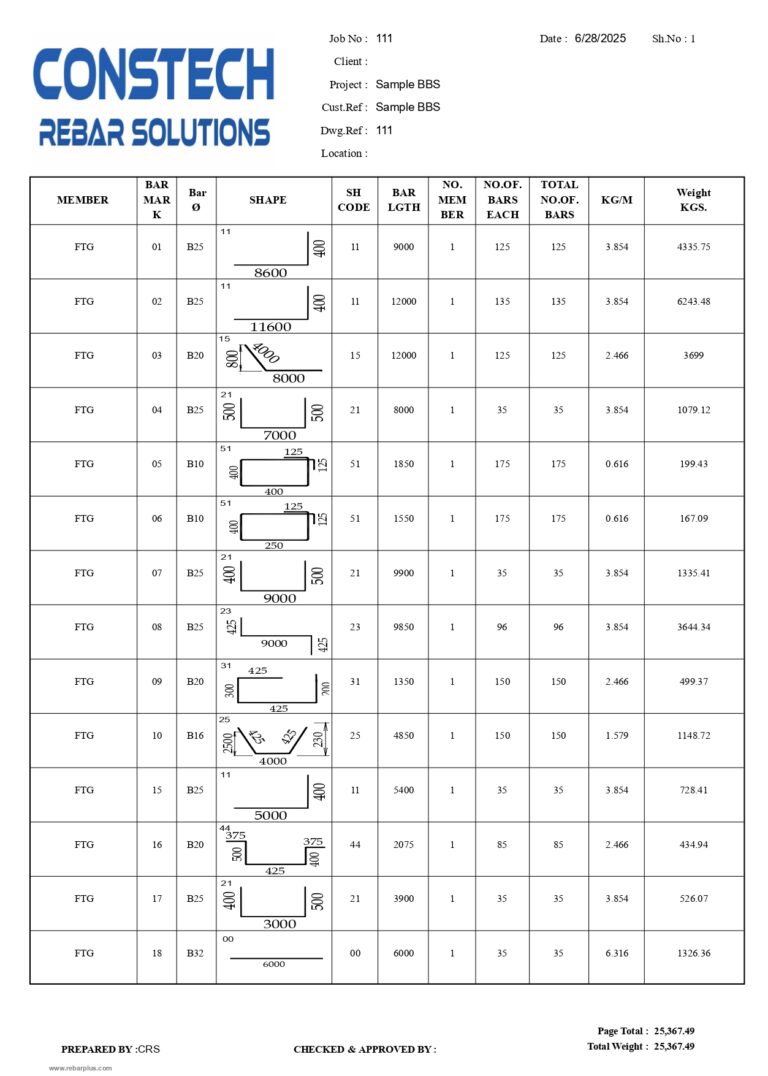
In reinforced concrete construction, Bar Bending Schedule (BBS) plays a critical role in ensuring that reinforcement steel is accurately fabricated, cut, and placed. Errors in BBS can lead to material wastage, cost overruns, and structural issues.
This comprehensive guide explains BBS preparation step-by-step, including cutting length calculations, shape codes, and practical examples, based on BS 8666 standards widely used in the UK, Middle East, and international projects.
What is Bar Bending Schedule (BBS)?
A Bar Bending Schedule (BBS) is a detailed tabular representation of reinforcement bars required for a structure.
It includes:
- Bar mark
- Diameter
- Shape code
- Dimensions (A, B, C, etc.)
- Cutting length
- Quantity
- Total weight
👉 BBS acts as a bridge between design drawings and site execution.
Why BBS is Important in Construction
✔ 1. Accurate Quantity Estimation
Ensures precise steel requirement calculation.
✔ 2. Cost Control
Reduces excess ordering and wastage.
✔ 3. Faster Construction
Pre-cut and bent bars improve site productivity.
✔ 4. Standardization
Using BS 8666 ensures uniform communication across teams.
Components of a Standard BBS
|
Bar Mark |
Dia (mm) |
Shape Code |
A (mm) |
B (mm) |
C (mm) |
Qty |
Length (m) |
Weight (kg) |
Explanation:
- Bar Mark → Unique ID
- Shape Code → Defines bar geometry
- Dimensions → Based on BS 8666 notation
- Length → Calculated cutting length
Understanding Shape Codes (BS 8666)
Shape codes standardize reinforcement shapes.
Common Examples:
|
Shape Code |
Description |
|
00 |
Straight bar |
|
21 |
L-shaped bar |
|
11 |
U-shaped bar |
|
51 |
Cranked bar |
👉 These codes eliminate confusion between designers, detailers, and site engineers.
Cutting Length Calculation
Cutting length is the most critical part of BBS.
General Formula:
Cutting Length = Total Length – Bend Deductions + Hook Lengths
Factors Affecting Cutting Length
- Bend Angle
- 45°
- 90°
- 135°
- 180°
- Bar Diameter (D)
- Bend Radius
As per BS 8666, minimum bend radius depends on bar diameter.
Example Calculation
Problem:
Calculate cutting length for an L-shaped bar:
- A = 500 mm
- B = 800 mm
- Diameter = 12 mm
- 90° bend
Step 1: Total Length
Total = A + B = 500 + 800 = 1300 mm
Step 2: Bend Deduction
For 90° bend (approximate practical value):
Deduction ≈ 2 × Diameter = 2 × 12 = 24 mm
Step 3: Cutting Length
Cutting Length = 1300 – 24 = 1276 mm
Step 4: Convert to meters
= 1.276 m
Weight Calculation Formula
Weight of steel is calculated using:
Weight (kg) = D² / 162 × Length
Example:
For 12 mm bar:
= (12² / 162) × 1.276
= (144 / 162) × 1.276
≈ 1.13 kg per bar
Sample BBS Entry
|
Bar Mark |
Dia |
Shape |
A |
B |
Qty |
Length (m) |
Total Weight |
|
B1 |
12 mm |
21 |
500 |
800 |
20 |
1.276 |
22.6 kg |
Common Mistakes in BBS Preparation
❌ Incorrect Shape Codes
Leads to fabrication errors.
❌ Ignoring Bend Deduction
Results in wrong bar lengths.
❌ Unit Conversion Errors
mm ↔ m mistakes are common.
❌ Missing Bar Marks
Creates confusion on site.
Best Practices for Accurate BBS
✔ Always follow BS 8666 shape codes
✔ Double-check cutting length calculations
✔ Use standardized templates
✔ Perform quality checks before issuing drawings
✔ Use experienced detailers or specialized software
How Constech Rebar Solutions Adds Value
At Constech Rebar Solutions, we provide:
- High-precision rebar detailing
- Accurate BBS preparation
- International standard compliance (BS 8666)
- Optimized steel usage to reduce cost
👉 Our team ensures error-free detailing and efficient project execution.
Frequently Asked Questions (FAQ)
- What is BBS in construction?
BBS is a schedule showing details of reinforcement bars including length, shape, and quantity.
- Why is cutting length important?
It ensures correct fabrication and prevents steel wastage.
- What is shape code 21?
It represents an L-shaped reinforcement bar.
- Which standard is used for BBS?
BS 8666 is widely used internationally.
- How is steel weight calculated?
Using formula: D²/162 × Length.
Conclusion
A well-prepared Bar Bending Schedule (BBS) is essential for accurate construction, cost control, and structural safety. By following BS 8666 standards, engineers and contractors can ensure consistency and efficiency across projects.
For complex international projects, partnering with experienced detailing companies like Constech Rebar Solutions ensures precision, compliance, and optimized steel usage.
Need Accurate BBS & Rebar Detailing for Your Project?
👉 Contact Constech Rebar Solutions today for a free sample drawing and consultation.