
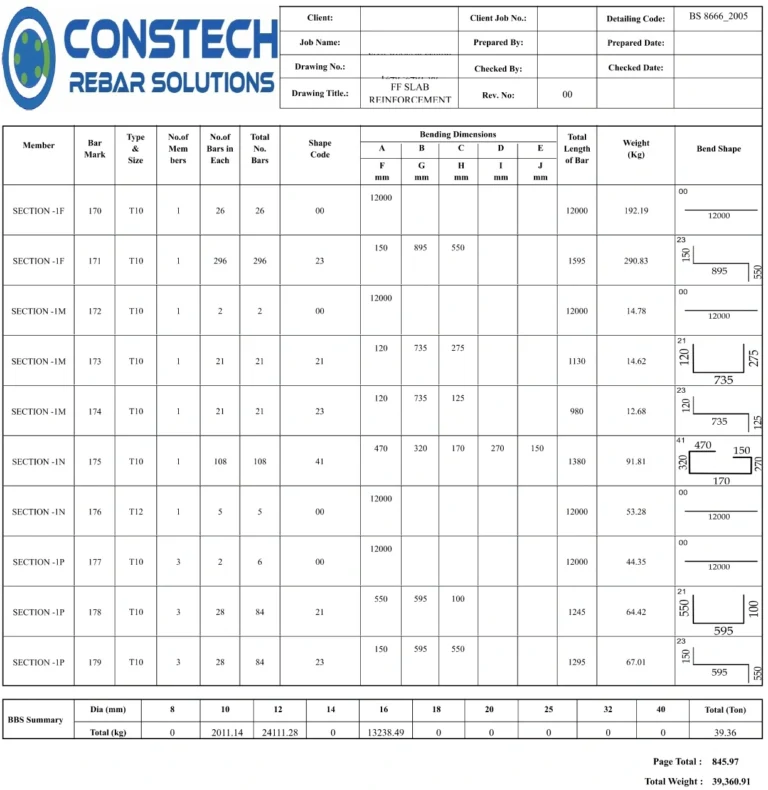
How to Prepare a BBS for Slabs, Beams & Columns
In modern construction projects, accurate reinforcement scheduling is essential for controlling steel quantity, minimizing wastage, and ensuring smooth site execution. A properly prepared Bar Bending Schedule (BBS) helps contractors, fabricators, and site engineers understand the exact reinforcement requirements before fabrication and installation begin.
For projects in the UAE, USA, and other international markets, BBS preparation has become a critical part of professional rebar detailing and shop drawing workflows.
This guide explains how to prepare a BBS for slabs, beams, and columns step by step.
What is a Bar Bending Schedule (BBS)?
A Bar Bending Schedule (BBS) is a detailed tabular document that shows:
-
- Bar mark numbers
-
- Bar diameters
-
- Shape codes
-
- Cutting lengths
-
- Spacing
-
- Number of bars
-
- Steel quantities
-
- Weight calculations
It serves as the link between structural drawings and actual steel fabrication.
A well-prepared BBS improves:
-
- Quantity accuracy
-
- Site coordination
-
- Material procurement
-
- Steel wastage control
-
- Fabrication efficiency
- Construction speed
Why BBS is Important in Construction Projects
1. Accurate Steel Quantity Estimation
BBS helps contractors estimate reinforcement quantities accurately before procurement.
2. Reduces Steel Wastage
Proper cutting lengths and bar optimization minimize material loss.
3. Faster Site Execution
Site teams can identify and place reinforcement quickly using bar marks.
4. Better Cost Control
Project managers can monitor steel consumption and budgeting more efficiently.
5. Easier Fabrication
Fabrication yards receive clear cutting and bending information.
Main Components of a BBS
A standard BBS typically includes:
| Item | Description |
|---|---|
| Bar Mark | Unique identification number |
| Member | Slab / Beam / Column |
| Diameter | Bar size (T10, T12, T16, etc.) |
| Shape | Bent shape of reinforcement |
| Spacing | Distance between bars |
| Cutting Length | Total length of each bar |
| Quantity | Number of bars |
| Total Length | Combined length |
| Unit Weight | Weight per meter |
| Total Weight | Final steel quantity |
Step-by-Step BBS Preparation Process
Step 1 — Study Structural Drawings
Before preparing the BBS, review:
-
- Structural reinforcement drawings
-
- General notes
-
- Section details
-
- Bar spacing
-
- Cover requirements
-
- Lap splice details
-
- Development lengths
Coordination with structural engineers is extremely important to avoid reinforcement conflicts.
Step 2 — Identify Reinforcement Members
Separate the reinforcement according to structural members:
-
- Slabs
-
- Beams
-
- Columns
-
- Footings
-
- Walls
-
- Staircases
Each member should have its own bar marking sequence.
Step 3 — Assign Bar Marks
Each reinforcement bar receives a unique bar mark.
Example:
| Bar Mark | Description |
|---|---|
| S1 | Slab bottom main bar |
| S2 | Slab distribution bar |
| B1 | Beam top bar |
| B2 | Beam stirrup |
| C1 | Column vertical bar |
| C2 | Column ties |
Bar marks simplify fabrication and site identification.
Step 4 — Calculate Cutting Lengths
Cutting length is calculated based on:
-
- Member dimensions
-
- Bend allowances
-
- Hook lengths
-
- Anchorage
-
- Lap lengths
For example, beam stirrups require:
-
- Beam width
-
- Beam depth
-
- Concrete cover
-
- Bend deductions
Accurate cutting lengths are essential to avoid site adjustments.
Step 5 — Determine Number of Bars
Bar quantity depends on:
-
- Spacing
-
- Structural dimensions
-
- Reinforcement zones
Example for slab reinforcement:
If slab width = 5000 mm and spacing = 150 mm:
Number of Bars = (5000/150)+1 = 34
Always round appropriately according to project requirements.
Step 6 — Prepare Steel Weight Calculations
Modern rebar detailing software automatically calculates total steel weight directly from the reinforcement model and BBS data.
BBS Preparation for Slabs
Slabs generally include:
-
- Bottom main bars
-
- Top bars
-
- Distribution bars
-
- Additional reinforcement
-
- Edge bars
Important Considerations
-
- Proper spacing
-
- Crank bars if applicable
-
- Openings coordination
-
- Extra reinforcement near supports
-
- Development lengths
Typical Slab BBS Example
| Bar Mark | Dia | Spacing | Length | Qty |
|---|---|---|---|---|
| S1 | T12 | 150 mm | 5.2 m | 34 |
| S2 | T10 | 200 mm | 4.8 m | 26 |
BBS Preparation for Beams
Beam reinforcement usually includes:
-
- Bottom bars
-
- Top bars
-
- Extra top bars
-
- Side face reinforcement
-
- Stirrups
Important Beam BBS Checks
-
- Anchorage lengths
-
- Stirrup spacing
-
- Congested joint zones
-
- Lap positions
-
- Beam-column junction detailing
Typical Beam BBS Example
| Bar Mark | Dia | Shape | Length | Qty |
|---|---|---|---|---|
| B1 | T20 | Straight | 7.5 m | 4 |
| B2 | T10 | Stirrup | 1.4 m | 52 |
BBS Preparation for Columns
Column reinforcement includes:
-
- Vertical bars
-
- Ties / links
-
- Starter bars
-
- Lap zones
Important Column BBS Considerations
-
- Lap splice locations
-
- Tie spacing
-
- Seismic detailing
-
- Congested reinforcement zones
-
- Column-beam intersection coordination
Typical Column BBS Example
| Bar Mark | Dia | Description | Length | Qty |
|---|---|---|---|---|
| C1 | T25 | Vertical bar | 3.6 m | 12 |
| C2 | T10 | Column tie | 1.2 m | 40 |
Software Used for BBS Preparation
Modern projects in UAE and USA commonly use:
-
- Tekla Structures
-
- AutoCAD
-
- Revit
-
- CADS RC
-
- ASA
-
- Excel-based BBS systems
3D rebar detailing software improves:
-
- Clash detection
-
- Quantity accuracy
-
- Revision management
- Shop drawing integration
Common Mistakes in BBS Preparation
Incorrect Cutting Lengths
Small errors can create major steel wastage.
Missing Laps & Hooks
Incomplete detailing causes site confusion.
Duplicate Bar Marks
Can lead to fabrication errors.
Ignoring Concrete Cover
Results in inaccurate reinforcement dimensions.
Poor Coordination with Shop Drawings
BBS must always match the latest approved reinforcement drawings.
BBS Standards Used in UAE & USA Projects
Projects may follow:
-
- ACI standards
-
- BS standards
-
- ASTM references
-
- Project-specific consultant standards
International rebar detailing companies must adapt BBS preparation according to client specifications and local project requirements.
Role of Shop Drawings in BBS Preparation
BBS and shop drawings work together.
Shop drawings visually show:
-
- Bar placement
-
- Reinforcement arrangement
-
- Sections and details
BBS provides:
-
- Quantities
-
- Cutting lengths
-
- Fabrication information
Without coordinated shop drawings, BBS accuracy can be affected significantly.
Conclusion
Preparing a professional BBS for slabs, beams, and columns requires technical understanding, drawing interpretation skills, and careful quantity calculation. Accurate BBS preparation helps contractors reduce wastage, improve fabrication efficiency, and maintain smooth project execution.
For modern construction projects in UAE, USA, and international markets, integrating BBS preparation with advanced rebar detailing and shop drawing workflows has become essential for achieving higher productivity and construction accuracy.
FAQ
What is the purpose of a BBS in construction?
A BBS helps calculate reinforcement quantities, cutting lengths, and steel weights for fabrication and construction.
Which software is commonly used for BBS preparation?
Tekla Structures, AutoCAD, Revit, CADS RC, and Excel-based systems are commonly used.
Why is BBS important for contractors?
It improves quantity accuracy, reduces steel wastage, and simplifies fabrication and site execution.
Does BBS include steel weight calculations?
Yes. Modern detailing software automatically calculates steel quantities and total reinforcement weight.
Can BBS be prepared directly from 3D models?
Yes. Advanced BIM and rebar detailing software can generate BBS automatically from reinforcement models.