
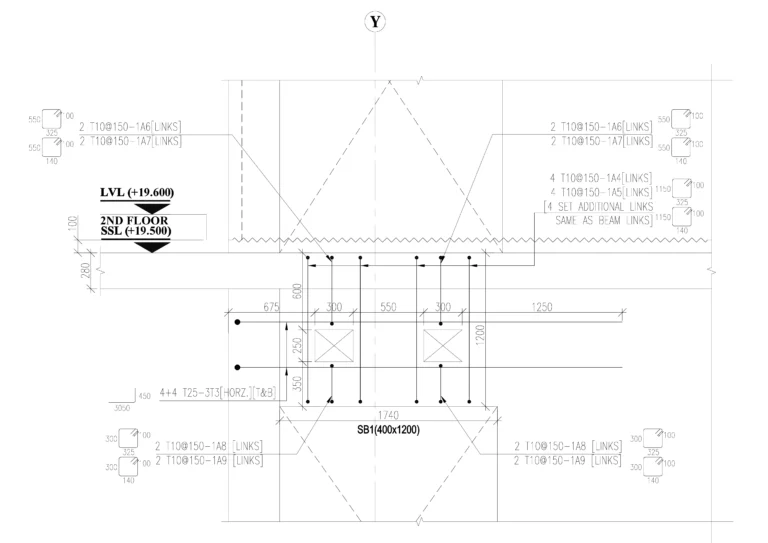
Development Length & Lap Splice Calculation as per ACI 318
In reinforced concrete structures, proper anchorage of reinforcement is critical to ensure that forces are safely transferred between steel and concrete. Two of the most important concepts in reinforcement detailing are Development Length (Ld) and Lap Splice Length (Ls).
Incorrect development or lap splice detailing can lead to cracking, bond failure, reduced structural performance, costly site corrections, and project delays. This is why understanding ACI 318 requirements is essential for structural engineers, rebar detailers, contractors, and steel fabricators.
This guide explains the fundamentals of development length and lap splice calculations as per ACI 318 and highlights practical detailing considerations used in projects across the USA, UAE, Canada, Australia, and other international markets.
What is Development Length?
Development Length (Ld) is the minimum embedded length of a reinforcing bar required to develop its full design strength through bond between steel and concrete.
Simply put, the reinforcement must be long enough inside the concrete to prevent pullout when subjected to tension or compression forces.
Without sufficient development length:
- Bars may slip from concrete
- Structural capacity may be reduced
- Cracking may increase
- Anchorage failure can occur
Why Development Length is Important
Development length ensures:
- Safe force transfer between steel and concrete
- Proper load distribution
- Structural integrity
- Compliance with ACI 318 requirements
- Reduced risk of bond failure
In high-rise buildings, bridges, retaining walls, podium structures, and industrial facilities, proper development length is a critical part of reinforcement detailing.
Factors Affecting Development Length
According to ACI 318, development length depends on several parameters:
1. Bar Diameter
Larger bars require longer development lengths.
Example:
- #5 bar requires shorter anchorage than #11 bar.
2. Concrete Strength
Higher concrete strength improves bond performance.
Higher fc’ generally results in shorter development lengths.
3. Steel Yield Strength
Higher reinforcement grades require longer anchorage lengths.
4. Bar Location
Top bars often require additional development length due to reduced bond conditions during concrete placement.
5. Coating Type
Epoxy-coated bars generally require increased development length because coating reduces bond efficiency.
6. Confinement Conditions
Closely spaced reinforcement and adequate concrete cover improve bond characteristics.
Understanding Tension Development Length
Tension development length is used when reinforcing bars are subjected to tensile forces.
Typical applications include:
- Slabs
- Beams
- Core walls
- Shear walls
- Transfer girders
- Mat foundations
ACI 318 provides equations that account for:
- Bar size
- Concrete strength
- Reinforcement grade
- Concrete cover
- Transverse reinforcement
The final calculated value is incorporated into rebar shop drawings and construction detailing.
Compression Development Length
Bars in compression require different development lengths because compression bars transfer forces differently than tension bars.
Compression development lengths are generally shorter than tension development lengths.
Typical locations include:
- Columns
- Core wall boundary elements
- Compression zones of beams
- Vertical wall reinforcement
What is Lap Splice?
A lap splice is created when two reinforcing bars overlap for a specified length to transfer forces from one bar to another.
Instead of mechanical couplers or welding, overlapping bars provide continuity in reinforcement.
Lap splices are widely used because they are:
- Simple to install
- Cost-effective
- Easy to inspect
- Commonly accepted in construction practice
Types of Lap Splices
1. Tension Lap Splice
Used where reinforcement is subjected to tension.
Examples:
- Slabs
- Beams
- Wall reinforcement
- Foundation mats
Tension lap splices typically require longer lengths.
2. Compression Lap Splice
Used in:
- Columns
- Compression zones
- Core wall boundary elements
Compression lap splices are generally shorter.
ACI 318 Lap Splice Classes
ACI 318 commonly categorizes tension lap splices as:
Class A Splice
Used where a larger percentage of reinforcement is continuous.
Advantages:
- Shorter splice length
- Reduced steel congestion
Class B Splice
Used in more demanding situations.
Characteristics:
- Longer splice length
- Commonly used in heavily reinforced structures
The required splice class depends on structural design conditions and reinforcement continuity.
Common Locations of Lap Splices
Columns
Vertical bars are often spliced between floor levels.
Core Walls
High-rise core walls frequently contain lap splices for vertical reinforcement.
Shear Walls
Splices are carefully located away from critical stress zones.
Beams
Splices are typically positioned away from maximum moment regions.
Slabs
Lap splices are commonly provided in top and bottom reinforcement.
Common Mistakes in Development Length and Lap Splice Detailing
Insufficient Lap Length
One of the most frequent site issues.
Result:
- Reduced structural performance
- Inspection comments
- Rework
Incorrect Bar Location
Placing lap splices in high-stress zones can reduce effectiveness.
Ignoring Congestion
Large numbers of overlapping bars can cause:
- Concrete placement difficulties
- Honeycombing
- Construction delays
Using Standard Values Without Verification
Development length should always be checked against project-specific requirements.
Missing Detail in Shop Drawings
Unclear splice locations often lead to site confusion.
How Rebar Detailers Improve Construction Efficiency
Professional rebar detailing teams help contractors by:
- Identifying optimal splice locations
- Reducing reinforcement congestion
- Coordinating with structural drawings
- Improving constructability
- Minimizing RFIs
- Supporting faster approvals
Detailed reinforcement drawings allow fabricators and site teams to understand exact lap splice requirements before construction begins.
Best Practices for Development Length and Lap Splice Detailing
Review Design Notes Carefully
Project specifications may modify standard ACI requirements.
Coordinate with Structural Engineers
Any deviation should be approved by the engineer of record.
Minimize Congestion
Where possible:
- Stagger lap splices
- Use mechanical couplers
- Optimize bar arrangement
Verify Before Fabrication
Errors discovered after steel fabrication can be costly.
Use Accurate Shop Drawings
Detailed reinforcement drawings reduce site interpretation issues.
Development Length vs Mechanical Couplers
Many modern projects replace long lap splices with couplers.
Benefits include:
- Reduced reinforcement congestion
- Less steel consumption
- Easier concrete placement
- Improved constructability
- Faster installation
This approach is particularly beneficial in:
- High-rise towers
- Core walls
- Heavily reinforced transfer structures
Global Relevance of ACI 318 Requirements
Although developed in the United States, ACI 318 is widely referenced across international construction projects.
Projects in:
- United States
- United Arab Emirates
- Canada
- Australia
- Saudi Arabia
often use ACI-based reinforcement detailing requirements, making development length and lap splice knowledge essential for international engineering teams.
How Constech Rebar Solutions Supports Contractors
At Constech Rebar Solutions, our team prepares:
- Reinforcement shop drawings
- Bar Bending Schedules (BBS)
- Lap splice coordination drawings
- Development length detailing
- Core wall reinforcement detailing
- Beam and slab detailing
- Foundation reinforcement drawings
Our experienced detailers support contractors, fabricators, and consultants on projects across the USA, UAE, and international markets.
Conclusion
Development length and lap splice requirements play a vital role in ensuring safe and durable reinforced concrete structures. Proper application of ACI 318 provisions helps prevent bond failures, reduce site issues, and improve construction efficiency.
Accurate reinforcement detailing, coordinated shop drawings, and proper splice planning allow contractors to achieve smoother fabrication, faster installation, and better project outcomes.
Whether working on residential towers, commercial developments, infrastructure projects, or industrial facilities, understanding development length and lap splice requirements remains a fundamental aspect of successful reinforced concrete construction.
FAQ
What is development length in reinforced concrete?
Development length is the minimum length of reinforcement embedded in concrete required to develop the full strength of the bar through bond action.
What is the difference between development length and lap splice?
Development length anchors a bar into concrete, while a lap splice transfers force between two overlapping reinforcing bars.
Why are lap splices required?
Lap splices provide continuity of reinforcement when a single bar length is insufficient for the required structural member length.
Can lap splices be replaced by couplers?
Yes. Mechanical couplers are commonly used in heavily reinforced structures to reduce congestion and improve constructability.
Why are lap splice locations important?
Incorrect splice placement in highly stressed regions can reduce structural performance and may violate design requirements.